The AI Civil War: Elon Musk, OpenAI, and the $130 Billion Battle Over the Future of Intelligence
What began as a partnership between some of Silicon Valley’s most ambitious minds has evolved into one of the most consequential technology conflicts of the modern era.
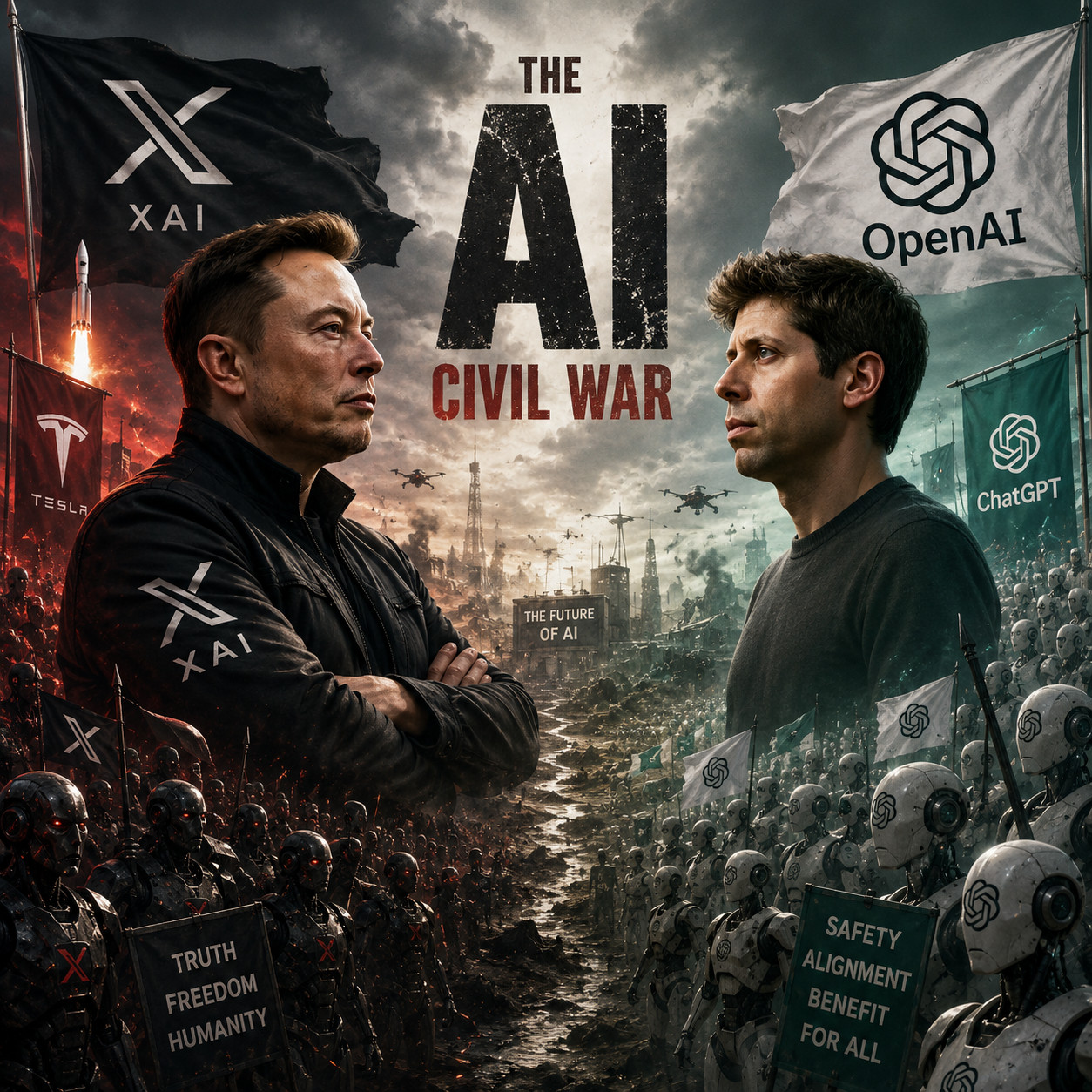
In a San Francisco courtroom, Elon Musk and OpenAI now stand on opposite sides of a legal and philosophical war that could shape the future of artificial intelligence itself. At stake is not merely money, though the figures involved are staggering. Musk is reportedly seeking more than $130 billion in damages. What is really unfolding is a fight over power, ideology, control, and the future direction of one of the most transformative technologies humanity has ever created.
The conflict carries the intensity of a corporate lawsuit, but beneath the legal filings lies something far more personal. Musk was not an outsider attacking OpenAI from the beginning. He was one of its founders.
When OpenAI launched in 2015, it positioned itself as an unusual entity in Silicon Valley: a non-profit artificial intelligence research organization dedicated to developing safe AI for the benefit of humanity. At the time, fears surrounding artificial general intelligence were still considered fringe concerns outside technical circles. Musk, however, had repeatedly warned that uncontrolled AI represented one of civilization’s greatest existential risks.
OpenAI’s original mission reflected that anxiety. The company promised openness, transparency, and research designed to prevent AI from becoming concentrated in the hands of governments or corporations. It was, at least publicly, framed as an ethical counterweight to the competitive secrecy dominating big technology companies. But the AI industry changed rapidly. Training advanced models required enormous computational power, elite engineering talent, and billions of dollars in infrastructure. Idealism collided with economics. OpenAI gradually transitioned toward a for-profit structure and formed a deep strategic partnership with Microsoft, whose multibillion-dollar investments transformed OpenAI from a research lab into one of the most commercially influential companies in the world.
ChatGPT became the defining consumer AI product of the decade almost overnight. And somewhere along the way, the relationship between Musk and OpenAI fractured completely. Now, years later, that fracture has become public spectacle. During the 2026 trial, Musk accused OpenAI CEO Sam Altman and President Greg Brockman of betraying the organization’s founding principles. In testimony that immediately dominated global headlines, Musk claimed he had been “hoodwinked” and “deceived” into believing OpenAI would remain committed to its non-profit mission.
According to Musk, the transformation of OpenAI into a commercially driven AI giant heavily intertwined with Microsoft represented not evolution, but exploitation. His legal team framed the shift as a breach of charitable trust and a fundamental corruption of OpenAI’s original purpose. OpenAI’s defense has been equally aggressive.
The company argues that Musk’s lawsuit is less about ethics and more about competition. Their attorneys claim Musk became hostile after failing to gain control over OpenAI years earlier and later launching his own competing AI company, xAI, along with its chatbot, Grok.
The implication is unavoidable: this is not simply a disagreement about philosophy. It is a battle between rival visions of who will dominate the AI economy. And increasingly, the AI economy looks poised to dominate everything else. What makes this dispute so culturally fascinating is that both sides claim to be protecting humanity while simultaneously racing to build systems of unprecedented power.
Musk presents himself as the warning voice, arguing that artificial intelligence is moving dangerously fast and becoming concentrated inside opaque corporate structures. OpenAI, meanwhile, portrays itself as accelerating innovation responsibly while delivering AI tools that millions of people now use daily.
The public is left watching two competing narratives unfold simultaneously. One side says AI must be controlled carefully before it becomes uncontrollable. The other argues that slowing progress risks allowing authoritarian governments or rival corporations to seize dominance instead. Both arguments contain truth. That tension reflects the larger contradiction defining the modern AI era. Artificial intelligence promises extraordinary breakthroughs in medicine, science, productivity, and education. But it also threatens labor markets, information integrity, privacy, and potentially the balance of global power itself.
The courtroom battle between Musk and OpenAI therefore feels symbolic of something much larger than a corporate feud. It is the first major ideological war of the AI age. And like many Silicon Valley conflicts, the personalities involved only intensify the drama. Musk remains one of the most polarizing figures in modern business, capable of being viewed simultaneously as visionary, provocateur, disruptor, and destabilizer depending on who is watching. Sam Altman, by contrast, has emerged as the calm architect of the AI boom, positioning himself as both technologist and diplomat while navigating governments, investors, and growing public scrutiny.
Their clash represents two different philosophies of innovation. Musk often operates through chaos, speed, and confrontation. OpenAI increasingly resembles institutional power: structured, capitalized, politically connected, and globally influential. Even the emotional undercurrents of the trial reveal how deeply personal the conflict has become. Court testimony reportedly included claims from co-founder Greg Brockman that he once feared Musk might physically attack him during a heated disagreement years earlier. Such details transform what might otherwise appear as abstract corporate litigation into something closer to Shakespearean tech drama, driven by ego, betrayal, ambition, and ideological fracture. Meanwhile, the broader public is beginning to confront a more uncomfortable realization: artificial intelligence is no longer a future issue. It is a present power struggle.
The companies shaping AI today are not simply building software products. They are building the infrastructure that may eventually influence economies, governments, warfare, labor, media, and human behavior itself.
Which raises the question quietly hovering beneath this entire legal battle:
Who should control intelligence at planetary scale?
That question once belonged to philosophy departments and science fiction novels. Today it sits inside a federal courtroom in California, attached to a $130 billion lawsuit involving some of the most powerful figures in technology.
And regardless of who ultimately wins, one thing already feels certain.
The age of artificial intelligence is no longer being built behind closed laboratory doors. It is becoming a public fight over power, ethics, money, and the future direction of civilization itself.
Listen to this article : https://bit.ly/4nbcQuo