Thailand’s Legal Crackdown, Investor Risks, and the Essential Authorities Every Foreign Buyer Must Know
Thailand has become one of Asia’s most attractive destinations for international property investment, luxury real estate, hospitality development, and retirement living. From the skyline condominiums of Bangkok to the beachfront villas of Phuket, resort developments in Pattaya, and lifestyle communities in Chiang Mai, foreign investment has played a major role in shaping the country’s property market.
In 2026, however, Thailand is no longer making headlines only for record tourism and rising property values. The country is now in the middle of a nationwide legal crackdown targeting foreign nominee ownership structures, illegal land holdings, undeclared beneficial ownership, and corporate structures designed to bypass foreign ownership laws.
For investors, developers, brokers, property owners, and international buyers, this has become one of the most important legal and investment stories in Thailand.
Why Thailand Is Investigating Nominee Structures
Thai authorities, led by the Department of Business Development, the Ministry of Commerce, immigration authorities, tax agencies, and financial investigators, have launched nationwide reviews of businesses suspected of using Thai nominee shareholders.
A nominee structure generally refers to a situation where Thai nationals appear as majority shareholders on company records while the foreign investor retains actual control of management, financing, or assets.
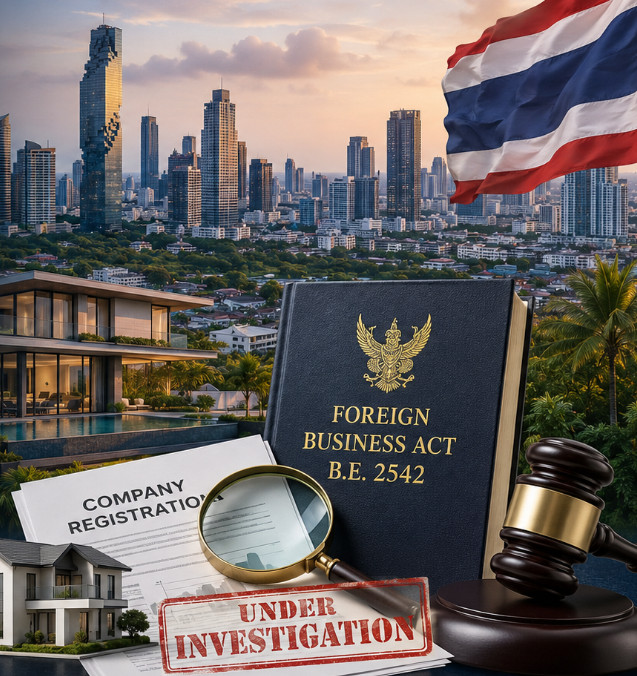
Under Thailand’s Foreign Business Act B.E. 2542 (1999), using nominees to operate restricted businesses may be illegal.
Authorities have confirmed expanded inspections across multiple provinces, including Bangkok, Phuket, Pattaya, Chiang Mai, Krabi, Hua Hin, and Koh Samui. Investigations focus heavily on sectors such as:
- Real estate
- Land holding companies
- Property management
- Construction and development
- Hospitality and resorts
- Tourism operations
Recent enforcement reports show authorities identified dozens of companies with suspicious ownership patterns requiring deeper examination.
What Authorities Are Looking For
Investigators are reviewing:
- Thai shareholders who did not fund their own shares
- Hidden foreign control through private agreements
- Offshore capital routed into Thai companies
- False declarations of capital contributions
- Shell companies with no real business operations
- Undisclosed beneficial owners
Thai authorities are also cross checking:
- Company registration records
- Tax declarations
- Bank transfers
- Land title registrations
- Visa and work permit records
Legal and financial enforcement teams are now working together more closely than ever.
Legal Risks for Foreign Investors
If a company is found to be using illegal nominee shareholders, penalties under Thailand’s Foreign Business Act may include:
- Up to 3 years imprisonment
- Fines from 100,000 to 1,000,000 THB
- Additional daily penalties for ongoing violations
- Forced company restructuring or dissolution
Legal experts say that legitimate foreign investors who use proper ownership structures, approved leases, condominium ownership, or BOI promoted companies are generally not the primary targets. The focus is on structures designed to hide actual control.
Top 10 Authorities and Professionals to Contact Before or After a Nominee Investigation
Before buying property, restructuring a company, or responding to an investigation, these are the most important contacts in Thailand.
1. Department of Business Development
Responsible for company registrations, shareholder investigations, and foreign business compliance.
Website: DBD Thailand
Phone: +66 2 547 4446
2. Department of Lands
Handles title deed checks, lease registration, land ownership verification, and due diligence.
Website: Thailand Land Department
Phone: +66 2 141 5555
3. Immigration Bureau
For investor visas, business visas, work permits, and foreign residency compliance.
Website: Thailand Immigration Bureau
Hotline: 1178
4. Thailand Board of Investment
For legal foreign investment structures, tax incentives, and BOI promoted companies.
Website: Thailand BOI
Phone: +66 2 553 8111
5. Department of Special Investigation
Handles corporate fraud, nominee investigations, and organized financial crime.
Website: DSI Thailand
Phone: +66 2 831 9888
6. Anti-Money Laundering Office
Reviews suspicious transactions, beneficial ownership, and source of funds.
Website: AMLO Thailand
Phone: +66 2 219 3600
7. Revenue Department
For tax compliance, capital verification, and shareholder financial audits.
Website: Revenue Department Thailand
Hotline: 1161
8. Law Society of Thailand
To verify licensed lawyers and legal advisors.
Website: Law Society of Thailand
Phone: +66 2 522 7124
9. Ministry of Commerce
Supervises national commercial compliance and business enforcement.
Website: Ministry of Commerce Thailand
Phone: +66 2 507 7000
10. Tourist Police Bureau
For fraud reporting, investor disputes, and emergency assistance for foreigners.
Website: Tourist Police Thailand
Emergency Hotline: 1155
Final Investment Outlook
Thailand is not closing its doors to foreign investors. Instead, the country is moving toward greater transparency, stronger enforcement, and higher compliance standards.
For serious buyers, developers, and luxury investors, 2026 may become one of the best opportunities to invest in Thailand with more confidence, better legal clarity, and stronger market protection.
The most successful investors in 2026 are no longer asking only where to buy in Thailand.
They are asking how to invest legally, protect capital, and structure ownership the right way.